
Earth’s Freshwater
Grades: 5
Type: Lesson Plans
Subjects: Science, Mathematics
Authors: Rachel Arbor
Location: Earth, North America > United States > Colorado
This resource has been reviewed by SubjectToClimate's climate scientists and verified for scientific accuracy and up-to-date information. Learn about our review process →
This resource has been reviewed by SubjectToClimate's climate scientists and verified for scientific accuracy and up-to-date information. Learn about our review process →
Synopsis
- This hands-on lesson uses a simple laboratory model and a pie chart to guide students in understanding how rare usable freshwater is on Earth.
- Students draw pie charts to represent the distribution of all the water on Earth.
Teaching Materials
Positives
- This hands-on activity will help students visualize Earth's water and understand issues related to water scarcity.
- Students will benefit from the mathematical connections in this resource.
Prerequisites
- The lesson plan suggests opening the lesson by checking on previously created water cycle in a bag experiments. Teachers can skip this part or precede the lesson with a related experiment.
- This activity requires students to measure in mL using graduated cylinders and be familiar with pie charts and calculating percentages.
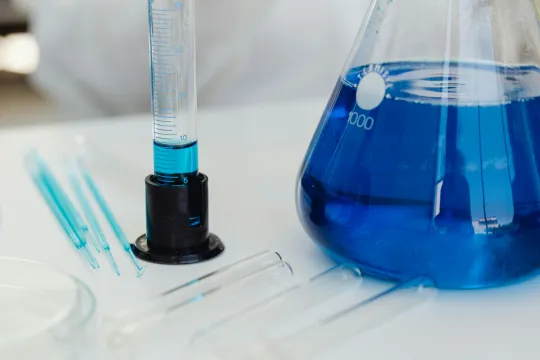
- Each student group will need 2 1000mL beakers, 3 50mL beakers, 1 1000 mL graduated cylinder, 1 25 mL graduated cylinder, 1 small cup of salt, 10 drops of blue food coloring, 2 pipettes, 2 spoons, and 4 Index cards.
- The discussion questions at the end of the lesson reference Colorado, but teachers can adjust these questions to fit their local context.
Differentiation & Implementation
- Depending on students' independence, students can work in groups, or the teacher can lead the activity by modeling the steps at the front of the class.
- To make connections to climate change, teachers can explain that, as the climate warms, the atmosphere can hold even more water, locking this away for longer until it comes back as precipitation. This podcast episode can help explain the connection.
- This lesson also includes optional extension activities for language arts, civics, and career exploration.
The slideshow features clear definitions of key terms, and connections to several STEM fields are included. No mention is made of how climate change affects freshwater, but this could be a simple extension. This resource is recommended for teaching.
Teaching Tips
Standards
Resource Type and Format
Scientist Reviewed
This resource has been reviewed by SubjectToClimate's climate scientists and verified for scientific accuracy and up-to-date information. Our review process ensures that every resource in our library reflects the current state of climate science.
Learn about our review process →